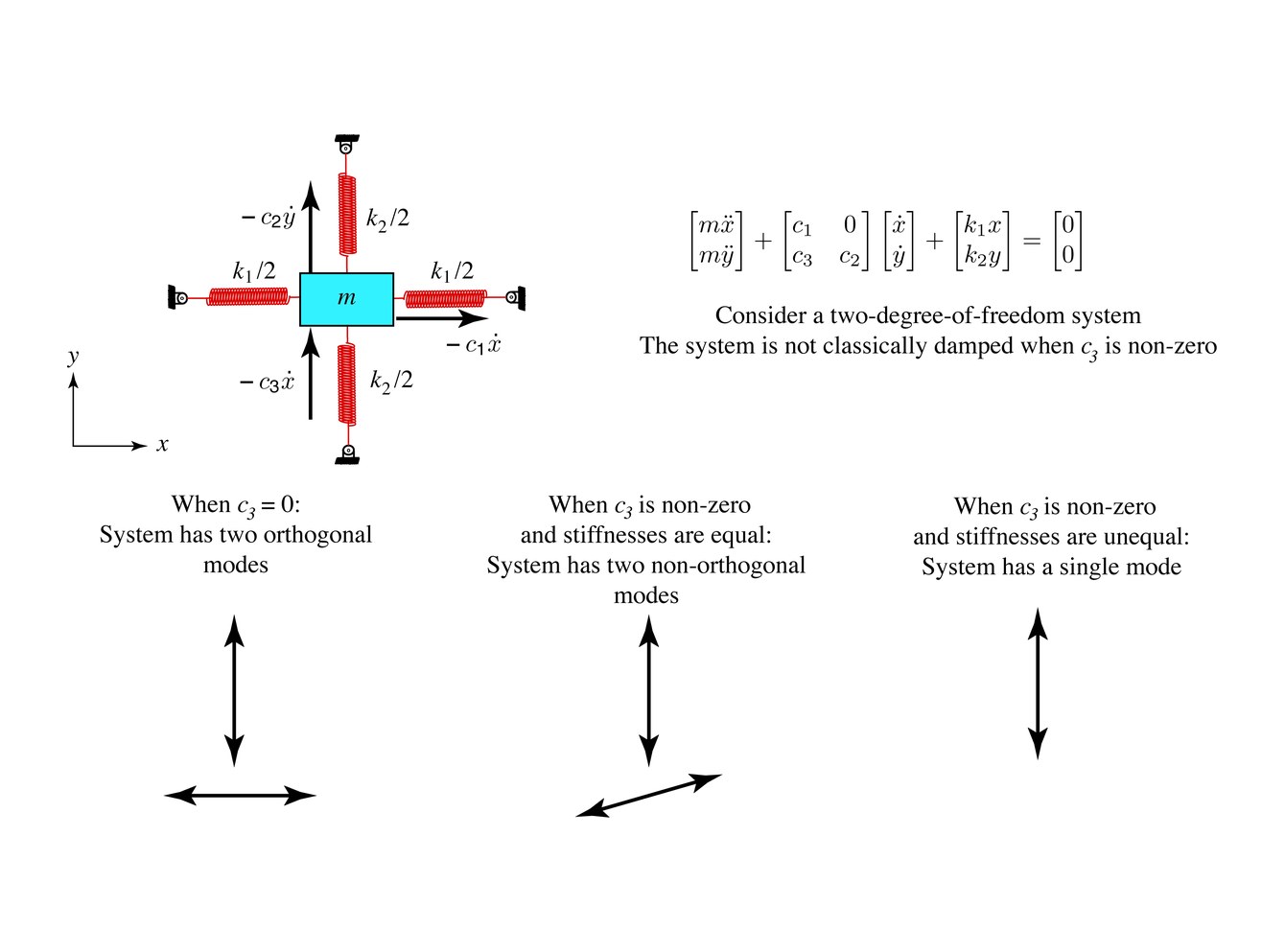
The number of modes of a mechanical system is generally assumed to equal its number of degrees of freedom. In this work, a simple non-classically damped system is shown to possess fewer modes than degrees of freedom unless a restrictive condition is met. When this condition is met, while there is a full set of modes, they are not orthogonal. These results hold for vanishingly small non-classical damping, can evade detection by the modal phase collinearity metric, and are relevant to system identification of mechanical systems in which non-classical damping is present.
@article{chern2026complexmodal,title={On Complex Modal Inverse Analysis: The Cautionary Tale of the Single Surviving Mode},author={Chern, Chrystal and O'Reilly, Oliver M.},journal={Journal of Applied Mechanics},volume={93},number={10},pages={101008},year={2026},publisher={American Society of Mechanical Engineers},doi={10.1115/1.4072378},url={https://doi.org/10.1115/1.4072378},}
Nonlin. Dyn.
The Symphony of Gyrations Producing Steady Motions of a Hula Hoop: Insights from a Network Analysis
Chrystal Chern, Theresa E. Honein, and Oliver M. O’Reilly
Hula hooping is a rhythmic activity where coordinated body movements induce a steady motion of the hoop. While a range of coordinated movements can successfully actuate the hoop, extracting the causal human motions for this multi-harmonic symphony of gyrations and rotations is an open problem that we seek to answer. Our methods use motion tracking of the body and hoop along with a network analysis for a single set of coordinated motions to establish that a specific rotation of the femur enables the tilting motion of the hoop and that specific rotations of the femur, tibia, and metatarsal enable the whirling motion of the hoop. The conclusions from network analysis are shown to be far superior to the results obtained from a principal component analysis and have application to human motion studies involving rehabilitation and assistive devices.
@article{chern2026hulahoop,title={The Symphony of Gyrations Producing Steady Motions of a Hula Hoop: Insights from a Network Analysis},author={Chern, Chrystal and Honein, Theresa E. and O'Reilly, Oliver M.},journal={Nonlinear Dynamics},volume={114},number={18},pages={1192},year={2026},publisher={Springer},doi={10.1007/s11071-026-13058-7},url={https://doi.org/10.1007/s11071-026-13058-7},}
JEM
Modal Clustering for Digital Twinning of Civil Infrastructure
Chrystal Chern and Khalid M. Mosalam
Journal of Engineering Mechanics (in preparation), 2026
@article{chern2026modalclustering,title={Modal Clustering for Digital Twinning of Civil Infrastructure},author={Chern, Chrystal and Mosalam, Khalid M.},journal={Journal of Engineering Mechanics (in preparation)},year={2026},}
MSSP
Detecting Inelasticity in Seismic Data with Time Response System Identification
Naiqi Guo, Chrystal Chern, and Khalid M. Mosalam
Mechanical Systems and Signal Processing (in preparation), 2026
@article{guo2026inelasticity,title={Detecting Inelasticity in Seismic Data with Time Response System Identification},author={Guo, Naiqi and Chern, Chrystal and Mosalam, Khalid M.},journal={Mechanical Systems and Signal Processing (in preparation)},year={2026},}
2025
EVACES
Structural Response Prediction from Learned System Realization Matrices
Chrystal Chern, Claudio Perez, and Khalid M. Mosalam
In 11th International Conference on Experimental Vibration Analysis of Civil Engineering Structures (EVACES), 2025
@inproceedings{chern2025evaces,title={Structural Response Prediction from Learned System Realization Matrices},author={Chern, Chrystal and Perez, Claudio and Mosalam, Khalid M.},booktitle={11th International Conference on Experimental Vibration Analysis of Civil Engineering Structures (EVACES)},year={2025},doi={10.1007/978-3-031-96110-6_72},url={https://doi.org/10.1007/978-3-031-96110-6_72},}
2024
JBE
Human-Machine Collaboration Framework for Bridge Health Monitoring
In bridge health monitoring (BHM), a prominent goal is to rapidly deliver assessment metrics for these essential and aging urban lifelines when subjected to natural hazard. A vibration-based machine learning (ML) BHM paradigm has been established over the past three decades to allow near-real-time automated health state classification, with a particular focus on the tasks of feature engineering and ML damage identification. This paper presents the human–machine collaboration (H-MC) framework to address challenges of this paradigm, especially in the context of reinforced concrete highway BHM. These challenges include specification of strong motion events, data multidimensionality, and ML model interpretability. The H-MC framework for BHM employs the techniques of multivariate novelty detection and probability of exceedance envelope models with ordinal filter-based feature selection to maximize the use of available data from both recorded and simulated events while maintaining the statistical and physical significance of the results. The framework is demonstrated using a numerical example and two case studies. The findings show the effectiveness of the proposed method for efficient damage assessment to facilitate rapid decision-making.
@article{muin2024humanmachine,title={Human-Machine Collaboration Framework for Bridge Health Monitoring},author={Muin, Sifat and Chern, Chrystal and Mosalam, Khalid M.},journal={Journal of Bridge Engineering},volume={29},number={7},pages={04024041},year={2024},publisher={American Society of Civil Engineers},doi={10.1061/JBENF2.BEENG-6587},url={https://doi.org/10.1061/JBENF2.BEENG-6587},}
4IBSW
Cross-Sectional Study of Physics-Informed Bridge Health Identification
Chrystal Chern and Khalid M. Mosalam
In International Association of Bridge Earthquake Engineering (IABEE) Fourth International Bridge Seismic Workshop (4IBSW), 2024
@inproceedings{chern2024physicsinformed,title={Cross-Sectional Study of Physics-Informed Bridge Health Identification},author={Chern, Chrystal and Mosalam, Khalid M.},booktitle={International Association of Bridge Earthquake Engineering (IABEE) Fourth International Bridge Seismic Workshop (4IBSW)},year={2024}}
Software
mdof: An Open-Source Python Package for System Identification
Chrystal Chern, Claudio Perez, and Khalid M. Mosalam
@misc{chern2024mdof,title={mdof: An Open-Source Python Package for System Identification},author={Chern, Chrystal and Perez, Claudio and Mosalam, Khalid M.},howpublished={Open-source Python package for system identification, Zenodo},year={2024},doi={10.5281/zenodo.11660200},url={https://doi.org/10.5281/zenodo.11660200},}
PhD
Digital Twin Framework for Vibration-Based Structural Health Monitoring
@phdthesis{chern2024dissertation,title={Digital Twin Framework for Vibration-Based Structural Health Monitoring},author={Chern, Chrystal},school={University of California, Berkeley},year={2024}}
Caltrans
BRACE2: Bridge Rapid Assessment Center for Extreme Events, Phase I Final Report
Chrystal Chern, Claudio Perez, and Khalid M. Mosalam
@techreport{chern2024brace2,title={BRACE2: Bridge Rapid Assessment Center for Extreme Events, Phase I Final Report},author={Chern, Chrystal and Perez, Claudio and Mosalam, Khalid M.},institution={State of California Department of Transportation},number={CA24-3703},year={2024}}
2020
SMIP20
Human-Machine Collaboration Framework for Bridge Health Monitoring
Sifat Muin, Chrystal Chern, and Khalid M. Mosalam
In SMIP20 Seminar on Utilization of Strong-Motion Data Proceedings, 2020
@inproceedings{muin2020humanmachine,title={Human-Machine Collaboration Framework for Bridge Health Monitoring},author={Muin, Sifat and Chern, Chrystal and Mosalam, Khalid M.},booktitle={SMIP20 Seminar on Utilization of Strong-Motion Data Proceedings},pages={100--127},year={2020}}
2019
MS
Deep Learning for Transmission Tower Structural Health Monitoring in Small Datasets
@mastersthesis{chern2019msreport,title={Deep Learning for Transmission Tower Structural Health Monitoring in Small Datasets},author={Chern, Chrystal},school={University of California, Berkeley},year={2019}}